
Industrial Flex Space Roofing in Greenville
Industrial Flex Space Roofing in Greenville
Industrial flex space roofing in Greenville, SC for multi-tenant low-slope roofs with heavy penetration counts, tenant-improvement modifications, and lease-transition risk. TPO, PVC, and metal systems.
The Most Variable Building Type We Roof
Industrial flex is the chameleon of the commercial inventory. One bay might be light manufacturing, the next a distribution hub, the next a contractor's shop or a tech tenant's lab and office, and a single building can hold all of those behind one long low-slope roof. The Upstate has a deep flex stock to match its economy, from the buildings packed into the SC Technology and Aviation Center on the old Donaldson Center grounds to the flex parks lining Pelham Road near I- and out toward Mauldin and Greer. A flex roof has to keep performing as uses change, as tenants come and go, and as each new occupant brings its own rooftop demands.
Multi-Tenant Means a Roof Full of Penetrations
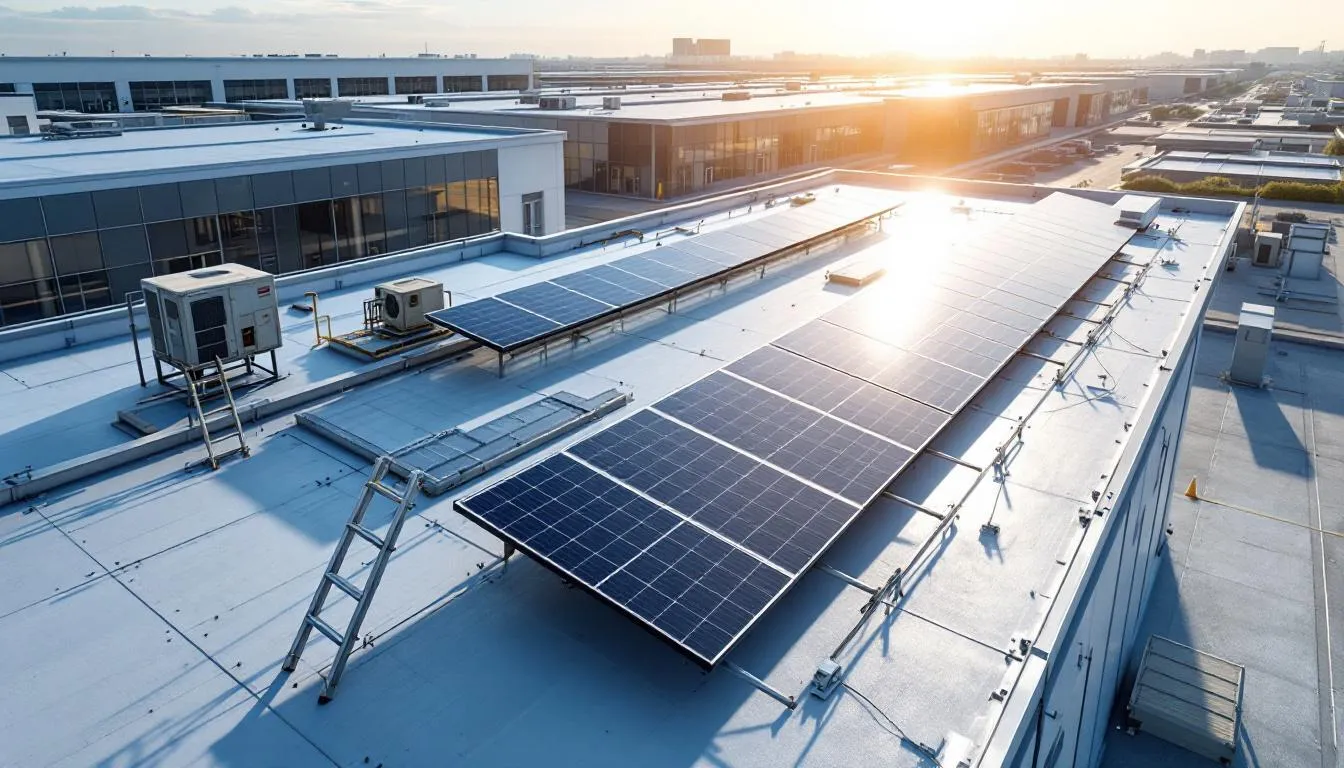
This is the core difference from a single-user industrial building. Every tenant improvement adds something to the roof: a new rooftop unit, a fresh electrical or gas run punched through the membrane, a piece of process equipment set without much thought for the original loading plan. Over a couple of lease cycles a flex roof accumulates a dense, layered field of penetrations, and a lot of them never make it into the property records. That is why we open every flex project with a penetration inventory survey. We are not assuming anyone cut corners; we are accounting for years of tenant-driven changes that no drawing set captured. With the demand from the BMW and Michelin supplier base and Upstate logistics keeping these buildings churning through tenants, that history stacks up fast.
Knowing the Deck Before Specifying the System
Greenville flex buildings run the gamut from 1970s and 1980s tilt-wall with aging built-up roofs to modern pre-engineered metal buildings with standing seam. The right reroof depends on the deck, the condition of what is already up there, and how much disruption the current tenants can absorb. For tilt-wall and concrete flex, our standard is a 60-mil TPO mechanically attached over new polyiso. On pre-engineered steel buildings we often look at a standing-seam recover or a coated-metal approach that extends service life without a full teardown. We pull a core where the existing assembly is in question, because recovering over saturated insulation just buries the problem.
Vacancy and Lease Transitions Are Where the Risk Hides
Investors and property managers feel this one. When a tenant leaves and its rooftop units come off, the curb openings are frequently left under temporary covers that do not survive more than a rain event or two of Greenville's summer storms. A flex inspection during lease transition should always confirm the status of those curb caps, verify that the departed tenant's penetrations were properly sealed rather than just abandoned, and check that the drains are clear. Vacant bays collect debris faster than occupied ones because nobody is up there noticing, and a clogged drain over an empty suite can flood it before the next showing.
Coordinating Across Tenants Who Share a Roof
Multi-tenant work runs on a good bay-by-bay occupancy map and a current contact list from property management. We identify which bays have active rooftop equipment, which sit vacant, and which tenants are sensitive to noise or HVAC downtime. Sequencing and daily dry-in get coordinated through the property manager, and tenants receive advance notice through that channel rather than fielding the crew at their back door. It keeps the project moving and keeps the manager in control of the tenant relationships.
How We Serve Greenville Flex Owners and Managers
- Full penetration inventory photographed and mapped up front, comparing the roof as-built to whatever records exist.
- Deck-matched systems, TPO or PVC over tilt-wall and concrete, recover or coating options over pre-engineered metal.
- Lease-transition inspections that confirm curb caps, abandoned penetrations, and drain clearance before a bay floods.
- Property-manager-led coordination across occupied and vacant bays with notice routed through management.
- Portfolio condition reports in a standardized format owners can use for capital planning across multiple properties.
For multi-tenant flex priced by the roof square, the variables are membrane spec, existing assembly condition, penetration density, and bay configuration, and we put a fixed price to it after a roof walk and a core where needed. Whether you hold one building off Pelham Road or a portfolio scattered across SCTAC, Mauldin, and Greer, we will document what is actually on the roof, match the system to the deck, and coordinate the work so your tenants stay productive and your asset stays protected.
Industrial Flex Space Roofing Questions
How do you handle undocumented tenant penetrations?
Our pre-project survey photographs and maps every roof penetration, compares it to the original drawings where they exist, and flags any non-standard or improperly sealed penetrations for remediation before new membrane goes down. That prevents warranty disputes after completion and gets ahead of leaks that would otherwise surface later.
What membrane is best for a multi-tenant flex building?
For tilt-wall and concrete flex, 60-mil TPO mechanically attached over tapered polyiso is the common, cost-effective choice. Where there is heavy rooftop equipment or frequent service-contractor foot traffic from multiple tenants, 80-mil TPO or 60-mil PVC fully adhered is worth the added cost for its better puncture and traffic resistance.
How do you coordinate work across tenants with different leases and schedules?
It starts with a bay-by-bay occupancy map and contact list from property management. We identify active rooftop equipment, vacant bays, and noise- or downtime-sensitive tenants, then coordinate sequencing and daily dry-in through the property manager. Tenants get advance notice through management rather than dealing with the crew directly.
How do you price flex roofing for investors and managers?
By the roof square, based on membrane spec, existing assembly condition, penetration density, and bay configuration. We give a fixed-price proposal after a roof walk and a core where needed, and portfolio owners receive standardized condition reports usable for capital planning across properties.
Do you handle standing seam metal roofs on pre-engineered flex buildings?
Yes. Pre-engineered metal buildings call for a different approach than flat membrane. We evaluate metal recover options, including silicone-coated metal and retrofit standing seam, against full replacement based on panel condition, purlin spacing, and load capacity, and we install both approaches in the Greenville area.
- Food Processing Facility Roofing
- Daycare Childcare Roofing
- Distribution Center Roofing
- Multifamily Apartment Roofing
- Religious Facility Roofing
- Roof Drains Scuppers
- Retail Roofing
- Built Up Roofing